


.BooyBYol.svg)












Rewiring a share registry's link to the Australian Securities Exchange, in under seven weeks.
ASX is replacing CHESS (the Clearing House Electronic Subregister System), which has cleared and settled every trade on the market since 1994 and keeps the record of who owns which shares. The replacement uses ISO 20022, a new global messaging standard, and every connected institution has to rebuild its integration to match it and pass ASX accreditation. Our client, a share registry serving Australia's listed companies, had started this work once before but stalled due to delays on the ASX platform requirements; this time the deadline was fixed.
Two forward-deployed engineers took it from first commit to the accreditation gate in forty-seven days.
Our client's link to CHESS needed to be upgraded, and fast.
They had started the migration to the new standard once before, and it had paused, part-built.
ASX set a deadline, and the client had only months to meet it. The hard part was the existing code, legacy and only partially migrated.
This is live financial infrastructure.
A single malformed message fails accreditation, and in production it can move real money the wrong way. There was no room for a wrong guess, and no way to rebuild from scratch.
realfast modernises in place.
We did not tear out a working system to start over. We helped our client update it to meet the new standard.
We mapped how the legacy core behaved before changing a line, worked spec-first so every message was defined before it was built, and checked each change on the real source system, not on our assumptions.
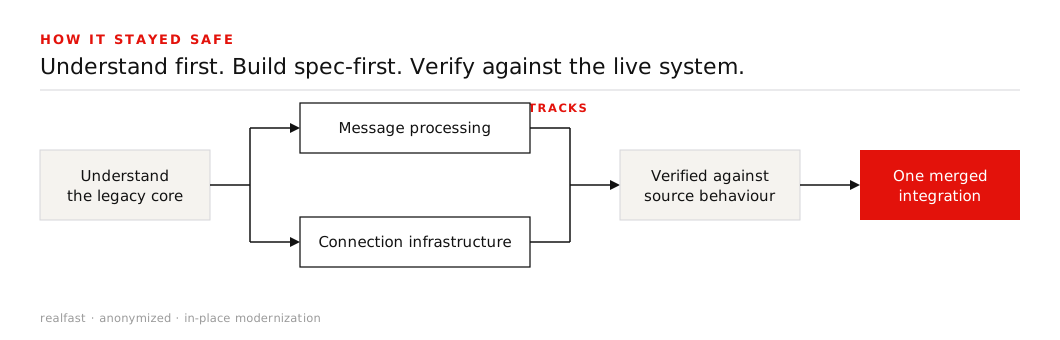
To hit the seven-week timeline, we split the work into two tracks: the message processing at the core of the accreditation scenarios, and the connection infrastructure through to production. Together they delivered the whole integration.
Small in surface area, unforgiving in correctness.
The scope was clear: three new ISO 20022 message flows, an inbound account notification and two outbound report requests, replacing five legacy EIS message types, with the exchange's four-message acknowledgment family handled in full.
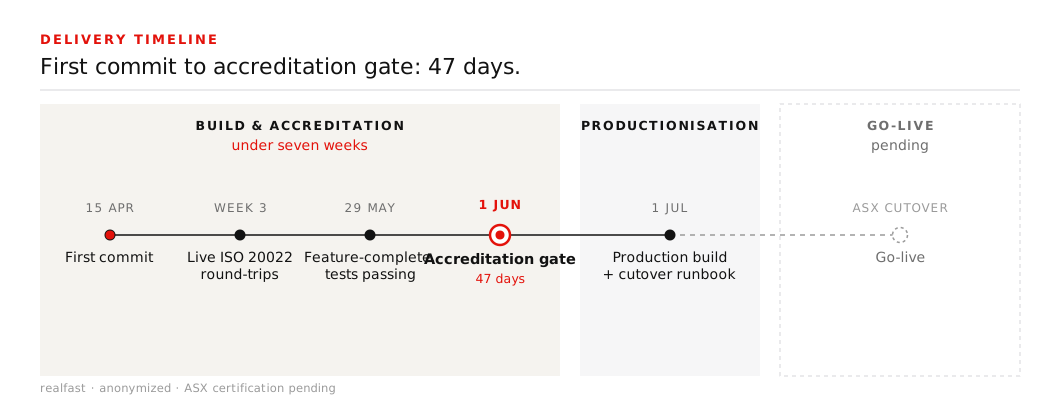
Within three weeks of starting, the integration was exchanging live ISO 20022 messages with the ASX test environment. One accreditation requirement, for example, was the reconnect behavior set out in the clearing house's connectivity guidelines; we built it as part of the resiliency work. By the end of May the feature work was complete and passing. On the first of June it reached the accreditation gate: forty-seven days from the first commit, under seven weeks.
Through late June the work was hardened and kept switched off in production, built for user testing, then for a production release. On the first of July it shipped with a production cutover runbook. The build is ready to switch on at the ASX cutover.
The proof: the core accreditation workflow passed 100% of its message tests. The connection service carried 400+ tests. The reporting screens passed all their tests. realfast accounted for every test note the client's analysts wrote, and closed the remaining gaps. ASX certification is pending.
A legacy system is not a lost one.
The fastest path through legacy infrastructure was to update what was there, hold it to the new standard, and prove every message with a test. It ships legacy software at modern-software speed, and skips the multi-year rewrite.
Our client owned their side of the work.
They ran product ownership, testing, and QA, and their business analyst cleared every open question as it came up. That ownership is what let two FDEs modernise a national clearing-house integration in superhuman time.
A legacy system and an immovable deadline are not a reason to panic.
They are a reason to call us.
Take this case study with you
Save a clean, print-ready PDF to share internally or send to your team.